
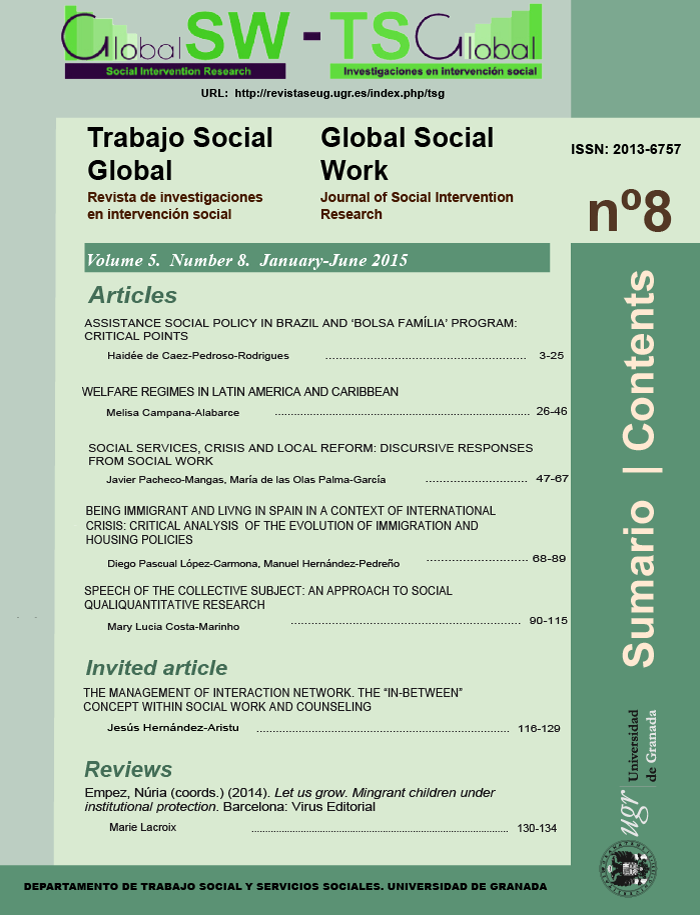
The management of interaction network. The “In-between” concept within Social Work and Counseling
DOI:
https://doi.org/10.30827/tsg-gsw.v5i8.3148Keywords:
Interaction, In-between, Therapy, Counseling, Social Work, Methodology, Reflexion, Interacción, "entre-dos", comunicación, terapia, asesoramiento, trabajo social, metodología, reflexiónAbstract
We are familiar with the field of group interaction through the traditional work of Kurt Lewin and also systemic thinking talks about network interaction that builds up the system. Martin Buber also discusses the “in-between” concept as the third element.The therapist or counselor, social worker and clients are part of an interaction network, representing therapeutic and social working situations. Success in treatment and reflective processes, depends on the perception and management of the situation by experts. Painting the moment of interaction offers the possibility to know what happens between professional and client. Afterwards it is possible to reflect on this experience.
Downloads
References
Bateson, G. et al: (1987). La nueva comunicación. (The new communication). Editorial Kairos.
Das gepfefferte Ferkel – Online Journal für systemisches Denken und Handeln. (The peppered pig – online journal for systemic thought and action). Juni 2005 (c) ibs Aachen
Buber, M. (1969). Reden über Erziehung. (Speeches about education). Lambert Schneider . Heidelberg.
_______ (1979). Das Dialogische Prinzip. (The dialogic principle). Lambert Schneider. Heidelberg.
Habermas, J. (1987). Teoria de la accion comunicativa, Vol. I and II. (Theory of communicative action, vol. I and II, Spanish version). Madrid: Taurus.
Hernández Aristu, J. (1991). Accion comunicativa e intervencion social. (Communicative action and social intervention). Madrid: Popular.
_______ (2008). The philosophy of Dialogue as the holistic Ethical Foundation in Assistance Careers. In: Brake/Deller (edit.) Community Development: a European Challenge, p.298-313. Opladen: Verlag V. Budrich.
Downloads
Published
How to Cite
Issue
Section
License
Authors publishing in this journal agree to the following terms:
- Authors retain their copyright. They guarantee to this journal the right to a first publication of the work submitted to initiate the editorial process.
- Authors know that their work is published under a Creative Commons License which allows others to share it, with a recognition of the work's authorship and its initial publication in this journal.
- Authors share with Global Social Work explotation rights of the work that has been published in this journal, authorizing the execution of a free reproduction, distribution and public communication. Authors know that their work will be stored on servers and reproduced in digital format for inclusion in institutional repositories and databases that will facilitates free access to the full text of the work.
- Authors may distribute the version of the work published in this journal (for example, to an institutional repository or publish it in a book), with the explicit acknowledgment of its initial publication in this journal.
Copyright on the texts published in Trabajo Social Global -Global Social Work, as well as editorial policy of the journal refering to self-file and deposit in institutional or thematic repositories, are identified in the database