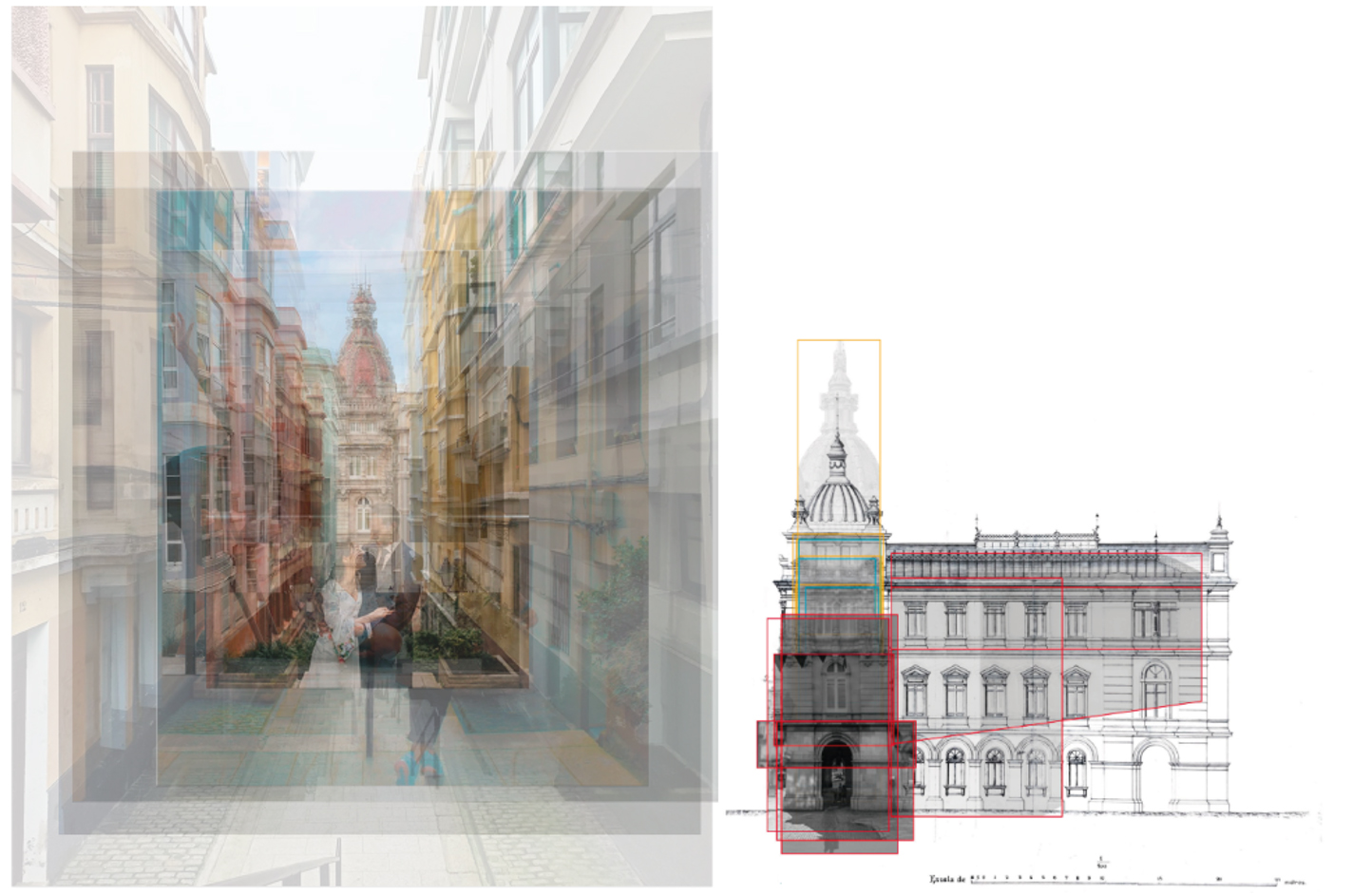


Unreal memories

La imagen colectiva de la arquitectura en redes sociales visuales

Autores/as

DOI:

https://doi.org/10.30827/sobre.v9i1.27015

Palabras clave:

comunicación visual, entorno construido, expresión gráfica arquitectónica, patrimonio cultural, visualización de datos

Resumen

Las imágenes de arquitectura se propagan rápidamente en las redes sociales visuales que ganan interés para difundir y comunicar la arquitectura. Por ello, es imprescindible diagnosticar el proceso de la construcción social de la imagen de la arquitectura, explorar las restricciones y formatos de publicación de la plataforma, identificar los hábitos de reacción y difusión con relación a los rasgos visuales de la fotografía y ahondar en las posibilidades y los riesgos que introducen los sistemas de inteligencia artificial (IA). El método de investigación sigue un enfoque de asociación cognitiva a través del análisis de varios estudios de casos gráficos en Instagram. El diseño exploratorio para abordar el papel de la imagen para comunicar la arquitectura en las redes sociales visuales surge del concepto de fragmento y de la visión sesgada, división requerida por la naturaleza de las sugerencias de imágenes relacionadas como método de navegación en Instagram. Los hallazgos identifican oportunidades y estrategias de acción para complementar los contenidos que construyen la imagen colectiva de la arquitectura adaptados a la lógica del nuevo escenario.

Descargas

Los datos de descargas todavía no están disponibles.

Biografía del autor/a

Ángel J. Fernández-Álvarez, Department of Architectural Graphics, University of A Coruña

Bsc of Building Engineering. Bsc of Humanities. PhD in Representation and theory of architecture from Universidade da Coruña. Professor at the Department of Architectural Graphics da Universidade da Coruña. He coordinates and teaches at Descriptive and Representation Geometry and Digital Graphic Tools for Building of the bachelor’s degree in Building Engineering and Smart Cities. Emerging technologies for sustainable cities in the Master in Sustainable Building. His research deals with the analysis of the influence of ICTs in the representation of architecture and the conception of space, as well as the relationships and hybridizations between art, science, technology, and architecture.

María Rodríguez-Grela, Department of Architectural Graphics, University of A Coruña

Research collaborator in the department of architectural graphics of the Universidade da Coruña through an internship from the Ministry of Education and Professional Training (2022-23) and previously from the the Universidade da Coruña (2020-21). María develops her final dissertation of the bachelor’s degree in architectural studies in the same department.

Citas

Al-Kodamy, K. (2019). Improving understanding of city spaces for tourism applications. Buildings, 9(8), 187. https://doi.org/10.3390/buildings9080187

Amado, A. (2022). Clouds and Red. Torres Blancas, Madrid [Photography]. Arquitectura Viva. https://arquitecturaviva.com/articulos/tres-camaras-indiscretas

Amado Lorenzo, A. and López-Chao, V. (2021). Analogue and Digital Access to Architectural Information. Interaction Design and Architecture(s), 47, 237-255. https://doi.org/10.55612/s-5002-047-011

Bakhshi, S., Shamma, D. A. and Gilbert, E. (2014). Faces engage us: Photos with faces attract more likes and comments on instagram. In M. Jones and P. Palanque (Eds.). Conference on Human Factors in Computing Systems - Proceedings (pp. 965-974). Association for Computing Machinery. https://doi.org/10.1145/2556288.2557403

Baudat, L. (2013). L’architecte, l’image et le mot: Le Corbusier dans Cahiers d’art (1926-1933). Les Cahiers de l’École du Louvre, 2, 1-14. https://doi.org/10.4000/cel.529

Boy, J. D. and Uitermark, J. (2017). Reassembling the city through Instagram. Transactions of the Insti-

tute of British Geographers, 42(4), 612-624. https://doi.org/10.1111/tran.12185

Cantón-Correa, F. J. and Alberich-Pascual, J. (2018). Construcción social de la imagen de una ciudad a través de Instagram: el caso de Granada. El Profesional de la Información, 28(1), e280108. https://doi.org/10.3145/epi.2019.ene.08

Carrasco-Polaino, R., Villar-Cirujano, E. and Martín-Cárdaba, M. A. (2018). Artivism and NGO: Relations-

hip between image and engagement in Instagram. Comunicar, 26(57), 29-38. https://doi.org/10.3916/C57-2018-03

Castells, M. (2015). Networks of outrage and hope: social movements in the internet age (2nd ed.). John Wiley & Sons.

Chen, T. L., Lai, W. C. and Yu, T. K. (2021). Participating in Online Museum Communities: An Empirical Study of Taiwan’s Undergraduate Students. Frontiers in Psychology, 11, 1-13. https://doi.org/10.3389/fpsyg.2020.565075

Cuerda, J. L. (2018). Tiempo Después [Film trailer]. Youtube. https://youtu.be/m09n5HTH2Qk

da Cruz, F. M. R. (2021). La organización de eventos públicos y disneyización de la sociedad:estudio de casos en el centro de la ciudad de Oporto. Aposta. Revista de Ciencias Sociales, 88, 30-48.

da Cruz, F. M. R. (2022). Etnopaisaje, turismo y ocio en la ciudad de Oporto. Un estudio exploratorio en Instagram. Aposta. Revista de Ciencias Sociales, 93, 43-59.

Depositphotos (2022). Gran Premio COAM 50: Torres Blancas [Photography]. Arquitectura Viva. https://arquitecturaviva.com/articulos/torres-blancas-y-madrid-rio-gran-premio-coam-50

Djafarova, E. and Rushworth, C. (2017). Exploring the credibility of online celebrities’ Instagram profiles in influencing the purchase decisions of young female users. Computers in Human Behavior, 68, 1-7. https://doi.org/10.1016/j.chb.2016.11.009

Falk, M. T. and Hagsten, E. (2022). Digital indicators of interest in natural world heritage sites. Journal of Environmental Management, 324, 116250. https://doi.org/10.1016/j.jenvman.2022.116250

Fernández-Álvarez, Á. J. and López-Chao, V. (2022). On behaviour and emotion: graphic approaches for architectural evaluation. BAc Boletín Académico, 12, 74-95. https://doi.org/10.17979/bac.2022.12.0.8862

Franco Taboada, J. A. (2011). Sobre perspectiva, fotografía e infografía. Apuntes para una fenomenología de la representación. On perspective, photography and infography. Notes for a phenomenology of representation. EGA. Revista de Expresión Gráfica Arquitectónica, 16(17), 54-65. https://doi.org/10.4995/ega.2011.883

Fuente Suárez, L. A. de la (2016). Towards experiential representation in architecture. Journal of Architecture and Urbanism, 40(1), 47-58. https://doi.org/10.3846/20297955.2016.1163243

Galloway, A. (2004). Protocol: How Control Exists after Decentralization. MIT Press.

Ghermandi, A. (2022). Geolocated social media data counts as a proxy for recreational visits in natural areas: A meta-analysis. Journal of Environmental Management, 317, 115325. https://doi.org/10.1016/j.jenvman.2022.115325

Graham, M., Zook, M. and Boulton, A. (2013). Augmented reality in urban places: contested content and the duplicity of code. Transactions of the Institute of British Geographers, 38(3), 464-479. https://doi.org/10.1111/j.1475-5661.2012.00539.x

Halbwachs, M. (1947). La mémoire collective et le temps. Cahiers Internationaux de Sociologie, 2, 3-31. https://www.jstor.org/stable/40688623

Kelley, M. J. (2014). Urban experience takes an informational turn: mobile internet usage and the unevenness of geosocial activity. GeoJournal, 79(1), 15-29. https://doi.org/10.1007/s10708-013-9482-1

Ledo Romay, L. (2021). Arquitectura y fotografía. La visión popular de la plaza de María Pita en Instagram [Trabajo Fin de Grado, Universidade da Coruña]. Repositorio institucional de la Universidade da Coruña. http://hdl.handle.net/2183/28203

López-Baeza, J., Serrano-Estrada, L. and Nolasco-Cirugeda, A. (2016). Percepción y uso social de una transformación urbana a través del social media. Las setas gigantes de la calle San Francisco. I2 Innovación e Investigación en Arquitectura y Territorio, 4(2). https://doi.org/10.14198/i2.2016.5.03

López-Chao, V., Amado, A. and Miotto Bruscato, U. (2022). A bibliometric approach to graphic procedures as a research method. EGA Revista de Expresión Gráfica Arquitectónica, 27(45), 218-231. https://doi.org/10.4995/ega.2022.16451

López-Chao, V. and López-Pena, V. (2020). Aesthetical appeal and dissemination of architectural heritage photographs in instagram. Buildings, 10(12), 1-15. https://doi.org/10.3390/buildings10120225

Lovink, G. (2011). Networks without a cause: A critique of social media. Polity Press. Luna Lozano, S. and Martín Martínez, J. V. (2022). El tiempo inconcebible. La fotografía como metáfora de la memoria en el arte contemporáneo. Fotocinema. Revista Científica de Cine y Fotografía, 25, 83-102. https://doi.org/10.24310/Fotocinema.2022.vi25.14478

Mahmoudi Farahani, L., Motamed, B. and Ghadirinia, M. (2018). Investigating heritage sites through the lens of social media. Journal of Architecture and Urbanism, 42(2), 199-211. https://doi.org/10.3846/jau.2018.7057

Ntoutsi, E., Fafalios, P., Gadiraju, U., Iosifidis V., Nejdl, W., Vidal, M., Ruggieri, S., Turini, F., Papadopoulos, S., Krasanakis, E., Kompatsiaris, I., Kinder-Kurlanda, K., Wagner, C., Karimi, F., Fernandez, M., Alani, H., Berendt, B., Kruegel, T., Heinze, C., Broelemann, K., Kasneci, G., Tiropanis, T., y Staab, C. (2020). Bias in data-driven artificial intelligence systems—An introductory survey. WIREs Data Mining and Knowledge Discovery, 10(3), e1356. https://doi.org/10.1002/widm.1356

PLEENS. (2020). Torres Blancas. [Music video]. Youtube. https://www.youtube.com/watch?v=-iOLu-9MA1eQ

Rodríguez Becerril, V. and Fortuna, C. (2021). Fotografiar espacios en deterioro: imágenes post-fotográficas de La Habana Vieja. Identidades territorio cultura patrimonio, 10, 1-17. https://doi.org/10.5821/id.10675

Saló Samarán, F. (2019). Renders habitados y arquitectura desierta. El mensaje oculto de la arquitectura revelado por la fotografía. Inhabited renders and desert architecture. The hidden message of Architecture revealed by photography. rita_revista indexada de textos académicos, 11, 80-86.

Tangana, C. and Veneno, K. (2021).

Thömmes, K. and Hübner, R. (2018). Instagram likes for architectural photos can be predicted by quantitative balance measures and curvature. Frontiers in Psychology, 9. https://doi.org/10.3389/fpsyg.2018.01050 [Music video]. Youtube. https://www.youtube.com/watch?v=vjWyRfnR5CQ

Valls, F., Redondo, E., Fonseca, D., Torres-Kompen, R., Villagrasa, S. and Martí, N. (2018). Urban data and urban design: A data mining approach to architecture education. Telematics and Informatics, 35(4), 1039-1052. https://doi.org/10.1016/j.tele.2017.09.015

Vionnet, C. (2011). Photo Opportunities. Kehrer Verlag. https://corinnevionnet.com/

Wyrwoll, C. (2014). Social Media. Fundamentals, Models, and Ranking of User-Generated Content. Springer Fachmedien Wiesbaden. https://link.springer.com/book/10.1007/978-3-658-06984-1

Zaparaín Hernández, F. (2015). Le Corbusier fotografía y difusión. La gestión de la imagen como actitud de vanguardia. rita_revista indexada de textos académicos, 4, 136-143.

Zhang, F., Zhou, B., Liu, L., Liu, Y., Fung, H., Lin, H. and Ratti, C. (2018). Measuring human perceptions of a large-scale urban region using machine learning. Landscape and Urban Planning, 180, 148-160. https://doi.org/10.1016/j.landurbplan.2018.08.020

Zhou, B., Liu, L., Oliva, A. and Torralba, A. (2014). Recognizing City Identity via Attribute Analysis of Geo-tagged Images. In D. Fleet, T. Pajdla, B. Schiele and T. Tuytelaars. (Eds.), Computer Vision – ECCV 2014 (pp. 519-534). Springer Cham. https://doi.org/10.1007/978-3-319-10578-9_34

Descargas

Publicado

2023-06-30 — Actualizado el 2023-07-18

Versiones

Cómo citar

Lopez-Chao, V., Fernández-Álvarez, Ángel J. y Rodríguez-Grela, M. (2023) «Unreal memories: La imagen colectiva de la arquitectura en redes sociales visuales», SOBRE, 9, pp. 31–42. doi: 10.30827/sobre.v9i1.27015.

Número

Sección

Panorama